 Last update date:


Quick Summary :-
Falling behind modern Node.js development? This guide reveals 2026’s most impactful Node.js trends, AI-ready architectures, serverless strategies and edge first deployment to help developers make powerful apps and stay competitive in tech world.Node.js takes top spot in full-stack development, powering everything from real‑time collaboration tools to mission critical systems. Backed by a vibrant open source community and optimized runtimes, Node.js is able to keep up with the latest demands of developers.
Its non-blocking I/O model & the zippy V8 engine performance make it possible for the likes of PayPal to create scalable microservices that hum along smoothly.
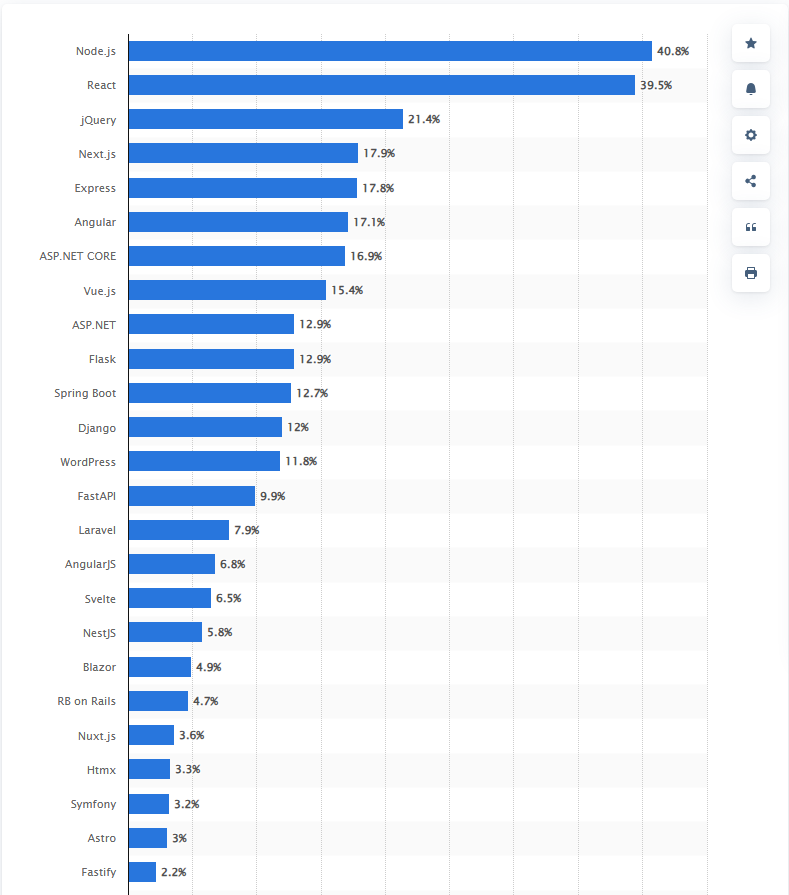
In 2024, a survey found that 40.8 % of developers use Node.js and Node.js overtook React.js as the world’s most used web framework.
Latest 20 Node.js Development Trends to Watch Out
A leading approach reshaping how developers build scalable Node.js backends.
1. Serverless Architecture
Runs event driven Node.js functions on AWS Lambda, Cloudflare Workers and Vercel, removing the need for server provisioning and maintenance overhead with pay‑per‑use billing models for Serverless App Development.
In 2026, advanced Lambda Extensions and Amazon EventBridge optimize cold start times and per‑function resource allocation, making auto scaling backends that elastically handle traffic surges while reducing operational costs and complexity.
Why It Matters:
Reduces operational overhead and costs, letting developers focus solely on business logic.
Real‑World Use Cases:
- Image thumbnail generation on AWS Lambda
- On demand PDF rendering via Cloudflare Workers
2. Node.js Is Open‑Source
Governed by the OpenJS Foundation there are over 1,000+ contributors that are driving LTS releases, security patches and transparent RFC processes all at zero licensing cost.
By March 2026, whole community led additions that bring native Fetch, Stable WebCrypto and enhanced Worker Threads that will deliver enterprise grade reliability and rapid innovation, fostering a thriving ecosystem for OSS projects and commercial platforms alike.
Why It Matters:
Community stewardship guarantees stability, security and continuous innovation at no license cost.
Real‑World Use Cases:
- Enterprises deploying LTS certified APIs
- OSS projects integrating bleeding edge V8 features
3. Streaming Applications
Uses the built‑in Streams API and HTTP/2 pipelines to deal with continuous media, logs and analytics all while controlling backpressure to stop buffer overload under heavy loads.
In 2026, developers chain and transform streams for live video feeds, server sent events and real‑time dashboards, keeping low latency and minimal memory usage for smooth user experiences.
Why It Matters:
Delivers uninterrupted, low‑latency data flows that scale with demand.
Real‑World Use Cases:
- Real‑time telemetry dashboards
- Live audio/video broadcasting platforms
4. Edge Computing
Executes Node.js functions at CDN edges Cloudflare Workers, Vercel Edge Functions, Fastly Compute@Edge, reducing latency and bandwidth consumption with geo‑distributed pops.
In 2026, Bun and Deno’s compatibility layers accelerate cold starts at the edge, enabling sub‑100 ms personalized content delivery, localized A/B testing and offline‑resilient logic without round trip delays to origin servers.
Why It Matters:
Brings computing near users for sub‑100 ms responses and enhanced reliability.
Real‑World Use Cases:
- Geolocation based content serving
- Personalized recommendations at CDN edge
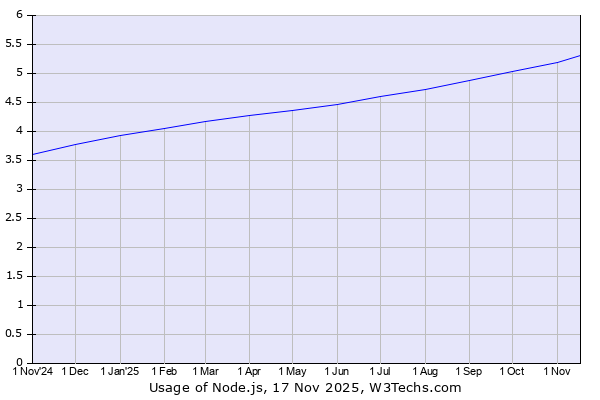
Did you know? Node.js now powers 5.3% of all websites with publicly known server stacks.
5. AI/ML Integrations
Embeds TensorFlow.js, ONNX Runtime and LangChain in Node.js backends to run real‑time inference on serverless GPUs or edge TPUs, eliminating cross language context switching.
In 2026, developers build fully JavaScript based AIO pipelines that preprocess input, invoke LLMs and post process outputs, powering personalization, anomaly detection and semantic search directly within production APIs.
Why It Matters:
Delivers smarter, adaptive user experiences directly within your JavaScript backend.
Real-World Use Cases:
- Contextual chatbots in support portals
- Real-time fraud detection in payments
6. Cross‑Platform Compatibility
Share code across desktop (Electron 25, NodeGUI), mobile (React Native) and web by leveraging unified NPM modules and monorepos (Nx, Turborepo).
In 2026, hot reload and live share debugging tools help feature parity and maintenance, so that developers can ensure consistent UI/UX Design and faster release cycles across all platforms from a single codebase.
Why It Matters:
Maximizes reuse, reduces duplication and shortens multi-platform release cycles.
Real-World Use Cases:
- Electron based chat clients
- Hybrid mobile/web apps with React Native for Web
7. Machine Learning Integration
Bridges Node.js and Python ML via PyBridge or ONNX HTTP servers to host heavy inference workloads alongside Express or Fastify APIs.
In 2026, real‑time pipelines perform image classification, NLP and recommendation model inference with integrated model monitoring that triggers automated retraining on drift events.
Why It Matters:
Combines rapid API development with robust machine-learning development capabilities.
Real-World Use Cases:
- On-the-fly image classification
- Dynamic content recommendation engines
As per the latest GitHub report, Node has been given 114K git hub stars and 33.8K Forks
8. Progressive Web Applications (PWAs)
Uses Express or NestJS to serve service worker scripts, web manifests and Workbox driven caching strategies for offline experiences.
By March 2026, Progressive Web Applications (PWAs) will support background sync and push notifications that rival native apps, helping fast load times, persistent state across sessions and improved engagement without app store friction.
Why It Matters:
Boosts engagement and retention by matching react native app performance without app store friction.
Real-World Use Cases:
- News readers with offline article access
- Persistent e-commerce shopping carts
9. Microservices
Deploys Node.js services in Docker containers orchestrated by Kubernetes or Nomad for independent scaling, deployments and polyglot stacks.
Service meshes (Istio, Linkerd) and Node.js 20’s Diagnostics Channel provide observability, traffic management and resilience, streamlining CI/CD pipelines across distributed microservice ecosystems.
Why It Matters:
Isolates failures, enables parallel microservice development and improves overall system agility.
Real-World Use Cases:
- Payment processing microservice in fintech
- User-profile service in social platforms
Also Read: Effective Microservice Best Practices for Building Scalable Applications
10. Internet of Things (IoT)
Orchestrates sensor networks with MQTT (Mosquitto), Node-RED flows and Johnny-Five hardware libraries on edge devices (Raspberry Pi, ESP32).
In 2026, AWS IoT Greengrass gateways handle real‑time telemetry and OTA firmware updates, leveraging Node.js’s event loop for responsive device fleet management.
Why It Matters:
Handles concurrent device streams with low overhead, critical for responsive IoT ecosystems.
Real-World Use Cases:
- Industrial automation sensor networks
- Smart building environmental controls
11. Cloud Computing
Integrates native SDKs (AWS SDK v3, Azure SDK, GCP libraries) to deploy Node.js services on Functions, Cloud Run and App Engine.
Infrastructure Code tools (Terraform, Pulumi) define compliant, reproducible environments enabling globally distributed, highly available backends in regulated industries with minimal manual intervention.
Why It Matters:
Enables scalable, governed backends that spin up globally in minutes.
Real-World Use Cases:
- Event-driven ETL pipelines on GCP
- Azure-powered notification services
12. Performance Optimization
Leverages Node.js 20’s startup time improvements, V8 JIT tuning and heap snapshots to profile and eliminate bottlenecks.
Automated performance budgets in CI (Lighthouse, Artillery) enforce sub‑100 ms API responses, guaranteeing consistent user experiences under peak loads and maintaining strict SLAs.
Why It Matters:
Maintains user satisfaction and meets strict SLAs under any traffic pattern.
Real-World Use Cases:
- Retail checkouts under 200 ms
- High-frequency trading dashboards
13. TypeScript Adoption
Enforces static typing in over 80% of projects, reducing runtime errors and open advanced IDE tooling and refactoring capabilities.
Frameworks like NestJS and tRPC ensure end‑to‑end type safety, while ESBuild’s native TS transpilation delivers near instant builds for seamless developer feedback loops.
Why It Matters:
Improves maintainability, developer productivity, and onboarding speed.
Real-World Use Cases:
- Large-scale APIs
- Cross-team shared library development
14. Enhanced Security Measures
Integrates automated npm audits, Snyk vulnerability monitoring and OWASP ASVS compliance checks into CI pipelines to catch issues early.
Uses Helmet.js for hardened headers, CSP to prevent XSS, JWT rotation and mTLS for zero‑trust service communication ensuring defense in depth in production.
Why It Matters:
Protects user data, averts breaches and maintains regulatory compliance.
Real-World Use Cases:
- HIPAA compliant healthcare portals
- PCI-DSS payment processing APIs
15. Scalability
Employs non‑blocking I/O, PM2 clustering and uWebSockets.js to handle millions of concurrent connections with minimal CPU overhead.
Auto scaling policies driven by custom metrics adapt services instantly to traffic surges, delivering resilient, consistent performance under unpredictable workloads.
Why It Matters:
Ensures consistent, high performance operation under unpredictable loads.
Real-World Use Cases:
- Live auction platforms
- Viral social media events
16. Single Language Full‑Stack
Leverages monorepos (Nx, Turborepo) to share validation logic and utilities between front end and backend in JavaScript/TypeScript.
Universal frameworks (Remix, SvelteKit) provide isomorphic routing and data fetching, accelerating unified feature development within a cohesive codebase.
Why It Matters:
Eliminates context switching and duplicate code, boosting team efficiency.
Real-World Use Cases:
- SaaS platforms with shared form validation
- Real time dashboards with fullstack rendering
17. MERN & MEAN Stack Evolutions
Modernizes MERN (MongoDB, Express, React, Node) and MEAN (MongoDB, Express, Angular, Node) with Next.js and Nuxt.js for SEO friendly SSR and CSR hybrids.
Turborepo and ESBuild accelerate build pipelines, boosting developer productivity and delivering performant fullstack applications in competitive markets.
Why It Matters:
Combines dynamic UIs with fast, server rendered content for better UX and search visibility.
Real-World Use Cases:
- Marketing sites with SSR
- Admin dashboards with dynamic routing
18. GraphQL for Efficient APIs
Implements Apollo Server or GraphQL Yoga to expose typed schemas that enable clients to fetch exactly the data they require.
Schema federation, persisted queries and caching layers optimize performance and security, future proofing API contracts and reducing over fetching across microservices.
Why It Matters:
Reduces over fetching, simplifies API evolution and future proofs data contracts.
Real-World Use Cases:
- Mobile apps with minimal payloads
- Unified data layer across microservices
19. Rapid Prototyping Stacks
Boots MVPs in hours using Yeoman generators, Create React App, or Vite combined with Supabase or Firebase backends.
Full featured scaffolds include authentication, database and hosting, minimizing boilerplate and accelerating idea validation for startups and hackathons.
Why It Matters:
Shortens time-to-market and de-risks product validation.
Real-World Use Cases:
- Hackathon demos
- Investor pitch prototypes
20. Enterprise Grade Solutions
Power mission critical workloads at PayPal, LinkedIn and NASA under LTS guarantees and commercial support from Red Hat and Snyk.
Integrates APMs (Datadog, New Relic) and rolling deployments to achieve zero downtime updates, reliability and compliance with enterprise SLAs.
Why It Matters:
Validates Node.js for high stakes, SLA driven applications in large organizations.
Real-World Use Cases:
- Global payment processing
- Scientific data analysis pipelines
Frequently Asked Questions
Real-time apps, enterprise APIs, AI/ML platforms, PWAs, and dashboards benefit from Node.js trends like WebSockets, microservices, TypeScript, WASM, GraphQL and serverless architectures for scalable, efficient solutions.
Node.js will advance with AI/ML integration, improved serverless and edge computing capabilities and broader adoption of TypeScript and WebAssembly. Security, scalability and developer productivity will remain central priorities.
Adopting serverless/microservices architectures, leveraging AI/ML for smarter features, using TypeScript for maintainability, integrating GraphQL for efficient APIs and prioritizing security/testing will keep businesses ahead in Node.js development.
In 2026, Node.js development trends include serverless architectures for scalability, edge computing for reduced latency, WebAssembly (WASM) for high-performance tasks, AI/ML integration, TypeScript adoption, microservices, GraphQL for efficient APIs and enhanced security practices.